


Wilmington College History Students Explore County’s Cemeteries
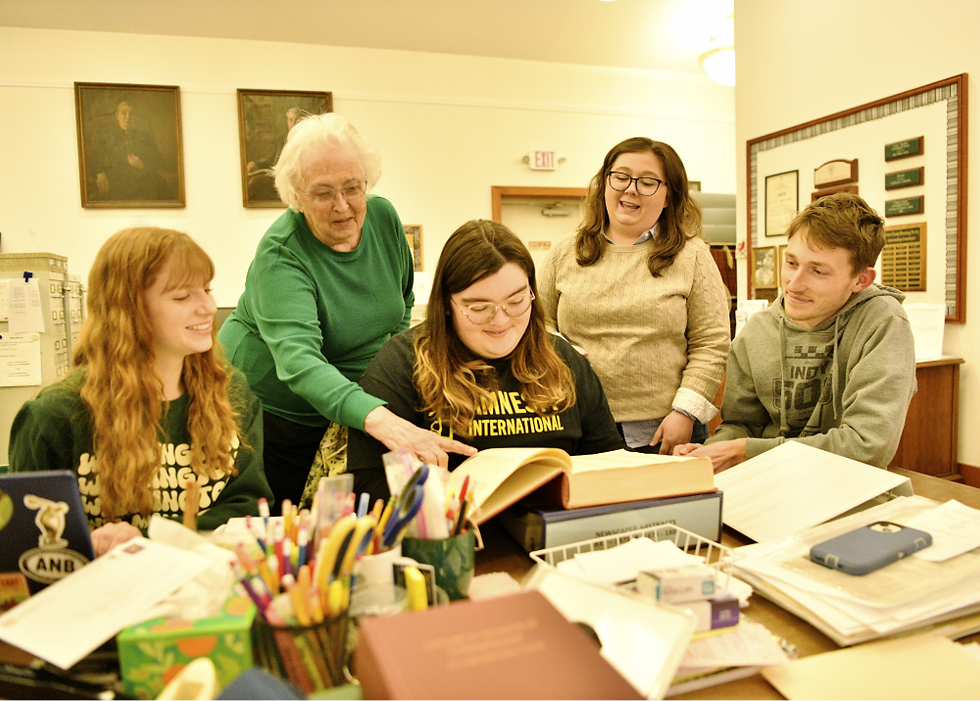
Wilmington, OH (December 11, 2025)—The English poet and author Chaucer wrote in the 1300s that, “Time and tide wait for no man.” Wilmington College sophomore Henry Hildebrandt and other members of the new student organization, WC History Council, are discovering that time has been relentless in obscuring an important part of Clinton County's history.
The History Council is undertaking a project to recover information from local cemeteries involving public records and gravestones that are badly weathered, misplaced, or missing. “Who’s buried there? Who has a headstone? What’s on the markers? A lot of these burials are from the 1800s, and many of the headstones are hard to read,” Hildebrandt said. He estimates that the county has at least 100 cemeteries, ranging from the large Sugar Grove in Wilmington, which has thousands of burial plots, to country church cemeteries and those with only family plots.
Hildebrandt, whose father introduced him to his love for history, considers the cemetery project a contribution to America 250, which celebrates the nation’s quarter-millennium in 2026. He noted how WC history Professor Keith Orejel encourages his students to “get involved” in history and suggested America 250 funding might be available to assist their research.
The History Council ultimately wishes to confirm accurate burial records to be stored at the Clinton County History Center, possibly displayed on a plaque at each cemetery and, ideally, even have those records digitally accessible through on-site QR codes at some of these small country burial grounds.
The WC students comprising the History Council have been conducting research in conjunction with the Clinton County History Center, where they are delving into news clippings, genealogical records, pension files, property/plot maps, and other historical sources. “With these documents, we can cross-reference all these cemeteries,” Hildebrandt said. Their trips to local burial grounds, often whose origins date back to the early 1800s, have uncovered a combination of readable and unreadable headstones, sunken grave markers, and even instances of missing gravestones and markers.
They have access to software that can decipher weathered engravings on gravestones via three-dimensional scans of marker photos. “This software can help figure out the inscription,” he said, noting it reveals images not readily seen by the naked eye. “That helps with reading them and provides a snapshot of what the cemetery looks like in 2025.”
The Wilson Family Cemetery, just east of Wilmington on US 22/Ohio 3, has been of keen interest to the group. It’s very run down with two existing headstones, several buried markers, and gravestones leaning against a tree. This family plot dates back to the first half of the 19th century. Indeed, a veteran of the War of 1812 was laid to rest there. “We have a good record of who’s buried there,” he added.
Hildebrandt said persons dating back to the nation’s founding are interred in the county’s cemeteries. He cited the Gaddis Family Cemetery on Prairie Road near Wilmington, which is the final resting place for the earthly remains of Thomas Gaddis, a militia officer in the Continental Army. He was involved in such historically significant events as the Whiskey Rebellion, which was a tax protest in western Pennsylvania in the 1790s when George Washington was president, and the Crawford Expedition. This was an attempt, in 1782, to destroy Native American towns along the Sandusky River in the hope of ending attacks on American settlers on the western front of the American Revolution. Gaddis relocated to Clinton County in later life and died in 1834.
“A lot of interesting people were settlers in the county,” Hildebrandt said.
This project comes after Hildebrandt spent a summer internship assisting with an archaeological dig involving burial grounds in Pickaway County. They excavated headstones and skeletal remains from cemeteries along the Ohio-Erie Canal near the Scioto River village of Lockbourne. Many buried there are believed to have been canal workers, Irish immigrants who died from cholera and were often placed in unmarked graves.
Shelby Boatman, executive director of the Clinton County History Center, was “ecstatic and amazed by their self-initiated interest” when Hildebrandt approached her proposing they collaborate on documenting these sites in the county. “We are always looking for volunteers and ways to continue telling Clinton County’s story,” she said. “Rural cemeteries — especially small family plots not connected to church burial grounds — are scattered across Clinton County. Many have been left to the mercy of time, with damaged headstones, incomplete or inaccurate burial records, and even a fading knowledge of where some sites are located.”
Boatman added that, through their partnership, the History Center has opened its records to the students after normal museum hours. “They have become our real-world ‘boots on the ground’ in the field,” she added, noting the students are learning the physical landscape of the county while also absorbing its heritage. “I have been especially encouraged to see a core group of students return to the History Center week after week with genuine excitement and a sense of wonder. It is rare to find younger people not only drawn to this kind of work but committed to seeing it through.”
The History Center plans to develop a Webpage that will share biographies of the individuals the students have documented. “We also hope to collaboratively install historical signage at these cemetery sites — both to educate visitors about each site’s heritage and to highlight the important research completed by Henry and the students.”
Article Submitted by Wilmington College


